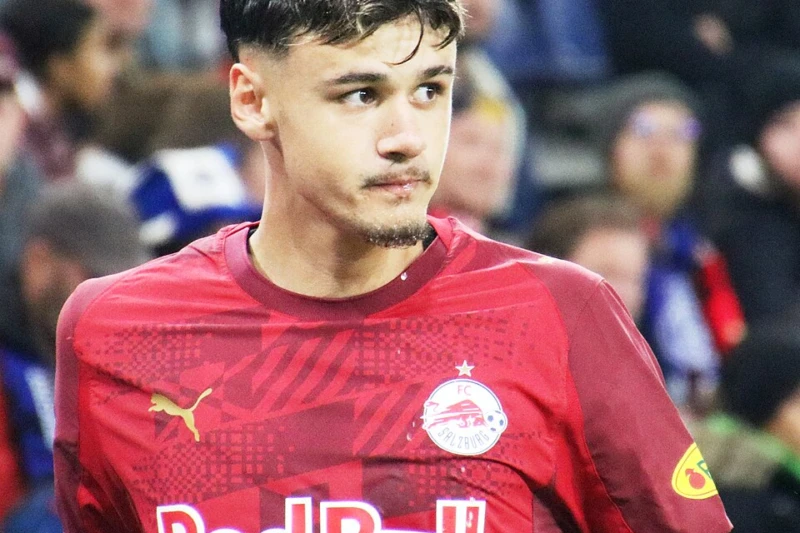


Mora can turn and drive into space, combine with those around him, or pick apart a defensive block with a killer through ball. Rarely content with conservative possession, he plays with a seemingly instinctive intention to make something happen.
Standing at 5’6″ (1.68m), his low-centred frame is a clear advantage with the ball at his feet. His low centre of gravity allows him to shift direction without sacrificing control, using feints and constant adjustments to wrong-foot defenders before bursting past them at pace. In tight areas, this frame is complemented by his elite ball mastery, allowing him to weave through challenges with the ball ‘on a string’. When afforded room to build momentum, especially at pace, his carrying shows visible fearlessness, and Mora can grab a game by the collar rather than ghosting by.
He is equally capable of creating for others, turning created space into valuable opportunities. His vision is partnered with an impressive weight of pass, allowing him to slip deliveries through crowded defensive blocks or turn and quickly combine around the edge of the box. Crucially, there is little reliance on any set method of creation. Mora can carry beyond his marker, play through him, or simply use the attention he attracts to open the game elsewhere, presenting a multi-faceted threat.
For all his willingness to create, he is far from reluctant to shoulder responsibility, regularly ghosting into threatening areas rather than facilitating possession. His breakthrough season at Porto serves as the clearest evidence of this, returning ten league goals and four assists at only 17 years old (FBref). It is this ability to switch between creator and finisher that makes a central role particularly intriguing.
Porto saw him flourish as a shadow striker in a 4-4-2. Playing alongside a true 9 (Samu Aghehowa under Porto) seems to suit him best, granting him the freedom to drop away to connect play before reappearing higher up the pitch, ultimately allowing the same freedom that fuels his creativity to also bring him within sight of goal. Rather than being tacked down to a certain task or position, Mora flourishes around a focal point, able to drop into pockets to receive before following up.
The appeal, therefore, lies less in assigning him to a certain zone and more in giving him a reference point to bounce from.
No player, however, is without faults.
While certainly capable of taking control of an attack, he isn’t yet consistent in doing so. There are periods in which his influence can fade, especially when denied space to turn and gather momentum. His tendency to rely on his instincts and trust his natural ability can occasionally result in an extra touch at times when the simple option would better serve the occasion. Most notably, his smaller frame can leave him vulnerable against more physical opposition. While his low centre of gravity is an advantage with the ball, defenders capable of stepping up to Mora early can disrupt him before he can get set or build momentum. Greater upper-body strength should help in this regard, though this should improve as he grows with age and adjusts to more physical environments.
Crucially, however, his size should not be confused with an unwillingness to compete; Mora remains an energetic presence without the ball, consistently determined to regain possession when lost.
Mora’s move to Gian Piero Gasperini’s AS Roma then presents an intriguing test. A central role could preserve Mora’s creative freedom while demanding greater discipline. The presence of Paulo Dybala feels particularly fitting. The comparisons are inevitable – both diminutive, technically gifted attackers capable of creating and scoring – but proximity may prove more valuable than similarity. In Dybala, Mora has a role model of sorts. However, the task is not to replicate him. Rather, it is to refine the qualities that define him.
Ultimately, the talent to command games is clear; the question is whether Roma can now help him find consistency among Europe’s elite.