
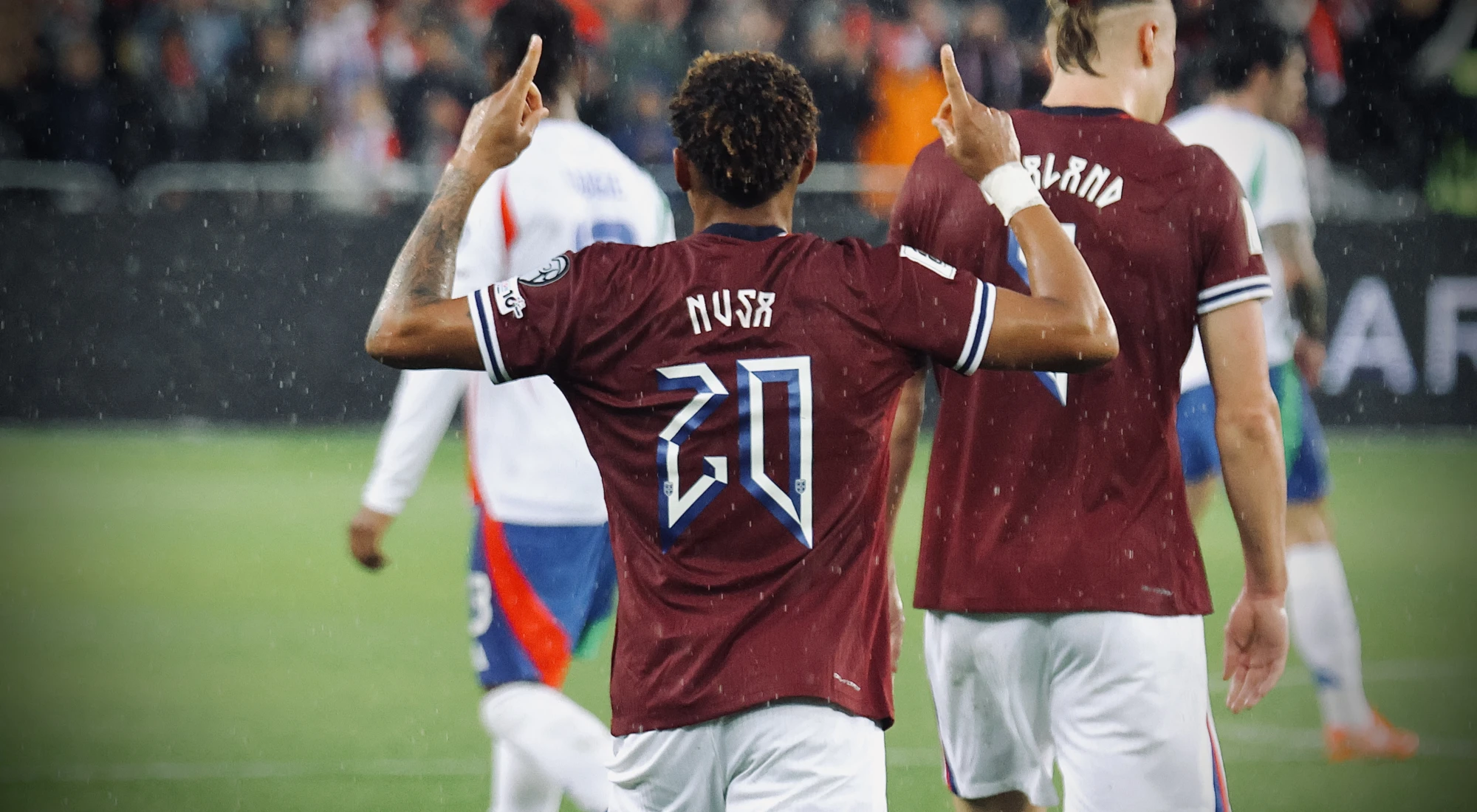

Aptly dubbed the “Norwegian Neymar”, Antonio Nusa has little interest in letting football slow down. Much like his childhood idol, every time possession reaches him, his instinct is to progress play rather than preserve it. Whether driving directly at a full-back or carrying into open space, he consistently looks to force the game onto the opposition before they have a chance to settle. It is a mentality that shapes every aspect of his game, one built on shouldering creative responsibility rather than waiting for opportunities to emerge.
Often the instigator, Nusa looks to create space, inviting defenders into one-on-one situations before leaving them behind with a swivel of the hips and a sharp change of pace. He is comfortable both cutting onto his right foot and staying on his left for a low-driven cross, consistently refusing to become predictable by presenting full-backs with a series of decisions rather than a single threat. This is reflected in the data, ranking in the 98th percentile for productive dribbles, 95th for progressive carries, and 96th percentile for carry VAEP (Valuing Actions by Estimating Probabilities) for forwards across Europe’s big five leagues.
Similar to his Brazilian idol, Nusa’s dribbling naturally draws attention. However, it differs in function, serving as a means of progression rather than the ‘jugador’ flair of the 2000s. Every successful carry forces defenders to retreat, disrupting opposition shape and creating opportunities for those around him. It is easy to simply look good, however. Impact is always a consideration. In this light, ranking in the 88th percentile for open-play expected assists and the 87th for expected threat created among forwards in Europe’s elite (ScoutLab) entails values in not only the number of men he can successfully take on but also the resulting attacking situations.
Although most comfortable operating from the left wing, Nusa has also featured on the right, and rather intriguingly, as a left wing-back within RB Leipzig’s 3-4-3 system. During a system change resulting from injuries, Nusa was pushed into a role that demanded greater defensive discipline. It is a role that some wingers such as Bukayo Saka began from, whereas some see it as the bane of their existence. Regardless, Nusa seemed largely unfazed by the extra responsibility, continuing to provide width, drive the ball forward and offer relentless support in transition, demonstrating an adaptability that should appeal to coaches who value tactical flexibility. (Premier League especially)
As is common with profiles his age, only 20 years old, there is clear room for refinement. Perhaps holding his title ‘Norwegian Neymar” slightly too close to heart, Nusa can occasionally hold onto possession for a touch too long, while improvements in crossing consistency would bring his attacking influence to greater heights. (Especially in boosting his end product.) It would be harsh, however, to treat these like irredeemable flaws. Rather, they are simple symptoms of his age and reflect the natural development arc of an already well-defined profile with experience in domestic and international football alike beyond his years.
Put simply, the foundations have been firmly placed at an age typically riddled with uncertainty both on and off the pitch.
While there are no guarantees in sport, Nusa’s game will likely evolve past the foundations of his identity that currently appear firmly established. Watching him, every reception seems to be treated as an opportunity to alter the course of an attack, every defender a problem to be solved. Questions of ceiling or potential aside, it is ultimately his willingness to consistently impose himself on games that has landed Nusa under the watchful eyes of Arsenal, AC Roma and Tottenham Hotspur.
From the outside looking in, it seems that whether he chooses to stick or choose a move abroad, the future is likely bright for Norway’s newest superstar.