
There are football clubs that spend decades chasing the immortality that winning the UEFA Champions League grants. Others spend those same years simply trying to survive.
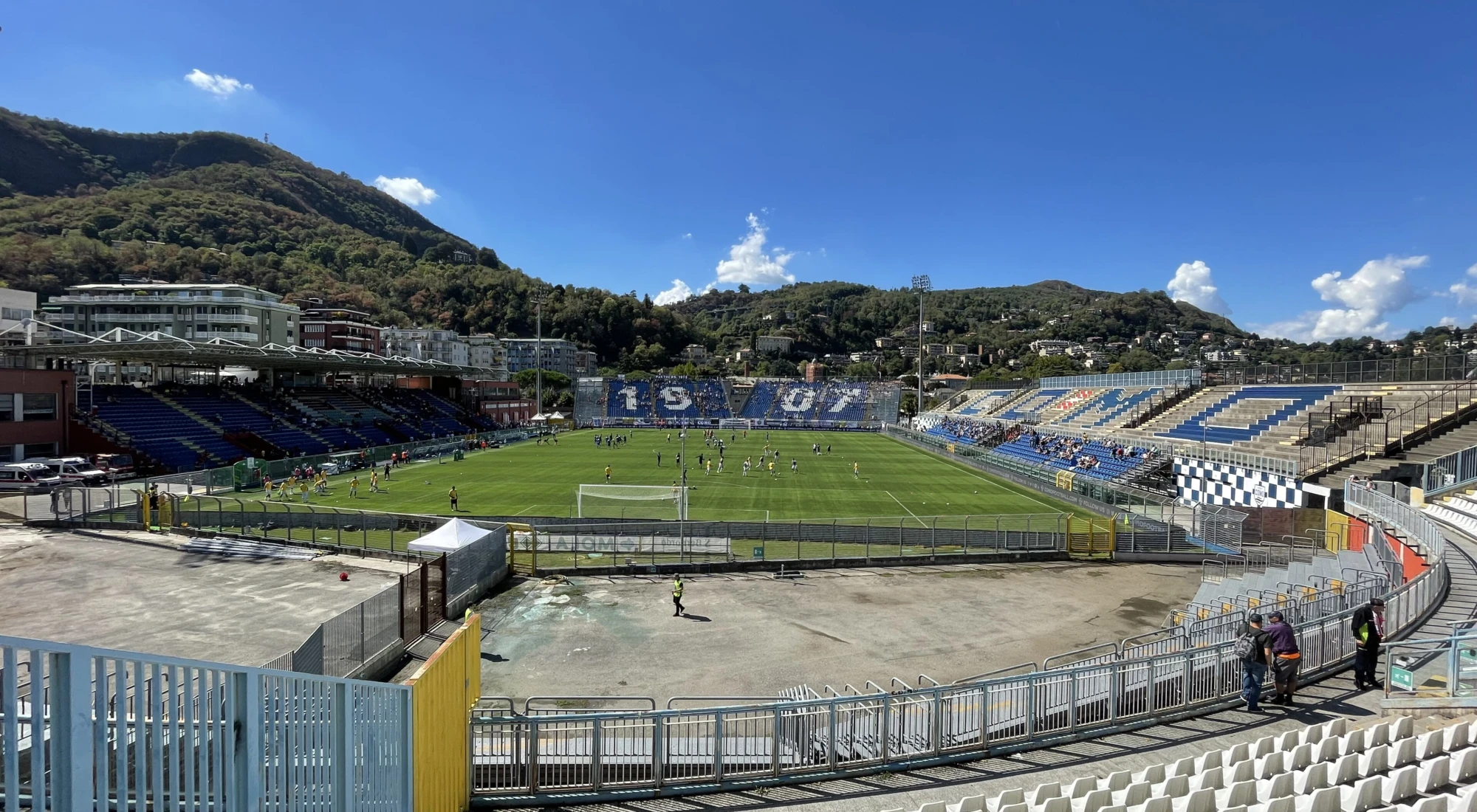
Less than a decade ago, Como 1907 found themselves fighting the latter battle. Financial collapse, failed ownership and a return to Italy’s amateur divisions left the club with more than a century of history confronting an uncertain future. In essence, European nights belonged somewhere else completely, with existence itself felt far less certain. Yet, in May 2026, those same supporters watched their club secure Champions League football for the first time in its history.
On paper, it contends with Leicester’s 2016 title winning season, reading as one of modern football’s most remarkable rises. The challenge, however, is knowing where the story truly begins.
Despite being the poster boy of Como’s resurgence, it doesn’t begin with Cesc Fàbregas on the touchline either. Nor does it begin with billionaire ownership, ambitious recruitment or a place among Europe’s elite. Rather, it began in 2016, when Como’s future as a professional football club seemed to be all but hanging in the balance.
Financial collapse forced the club into bankruptcy for the second time in only 12 years. Three consecutive auctions failed to attract a single bidder, leaving more than a century of footballing history teetering towards limbo. For a city whose identity had long been shaped by its natural beauty and tourism heritage, (Lake Como for instance) there was a growing possibility that Como 1907 may simply disappear from the professional game altogether. Therefore, when the club was re-founded and placed in Serie D for the 2017-18 season, the club had teetered right into the abyss.
European football wasn’t a star to aspire to; in fact, it wasn’t part of the conversation at all. After all, it’s impossible to shoot for the stars aboard a ship fighting to simply stay in orbit.
For two seasons, Como began piecing themselves back together. Promotion from Serie D was followed by another from Serie C, restoring the club to Serie B and, perhaps most importantly, a newfound sense of direction. Here, the conversation was not longer about the existence of Como’s future, but rather what it might look like. This shift coincided with a change in ownership. 2019 saw Indonesian conglomerate Djarum Group, through SENT Entertainment acquire the club for 850,000, with an additional 150,000 in order to clear the club’s debts.
However, unlike many modern takeovers, ownership ambition wasn’t announced through marquee signings or excessive spending. It began with something far less glamorous, yet perhaps the most vital: rebuilding the club itself from the ground up.
Of course, plenty of football clubs have been rescued by wealthy ownership. Manchester City, Wrexham AFC, Portsmouth, serve as standout examples of this. However, far fewer have been rebuilt completely. From day one, Como’s new owners displayed their belief in the cause, opting for long-term expenditure rather than cost-cutting, quick fixes. Promotion remained the primary ambition regardless, however it was never pursued at the expense of the club’s long-term future.
Much like Arsenal’s Mikel Arteta’s call to “trust the process”, it was an ownership philosophy that demanded patience and belief. After all, the objective was not to manufacture an overnight success story, but to build an environment capable of sustainable glory.
By the summer of 2022, Como had already climbed back to Serie B. The club has gathered itself, stabilised and began to lay the foundations for something more ambitious. Yet outside Italy, few had taken notice.
Then came a signing that changed this narrative completely.
Enter Cesc Fàbregas.
He arrived not at the peak of his career, but at the beginning of Como’s next chapter. Famous for his spells at Arsenal, Barcelona, Chelsea and Monaco, the World Cup winner could have easily been forgiven for treating the move as a gentle conclusion to an otherwise extraordinary career. Instead, he became part of something far more ambitious. While held dear to fans for his playing days at the club, Fàbregas’ true ambition became clear in his role beyond the pitch. After retiring, he joined Como’s coaching staff before eventually taking charge of the first team. In turn, becoming a living symbol of the project.
If the Hartono family’s investment had rebuilt the club’s foundations, Fàbregas became the footballing expression of a project that had begun to speak for itself. From that point onwards, success no longer represented the end of a journey. Rather, the benchmark for future endeavours. Every achievement quietly recalibrated ambition, replacing one objective with another as the club continued to evolve.
There was no defining breakthrough. Single Eureka moment that transformed Como overnight. Instead, progress revealed itself through patient accumulation. Every season seemed to strengthen belief. Every milestone reinforced the one before it.
What does this tell us?
The project wasn’t accelerated by success. It was validated by it.
Their 2026 Champions League qualification became the clearest expression of this philosophy. Less than a decade after fighting to survive, Como had reached Europe’s biggest stage- not by abandoning the process, but rather the opposite; a complete dedication to the cause.
For those outside of football, Lake Como is synonymous with postcard landscapes, celebrity villas
and Star Wars.
Obviously. For those who call it home, however, the football club has long stood for something far more personal. Like cities around the world, local football clubs serve as symbols of local identity. Como 1907 is no exception. To wear the badge is to represent a city that has spent decades resisting the cultural shadow cast by nearby Milan, preserving a footballing identity that remained unmistakably ‘Como’.
That is why promotion meant more than more than a simple transition from one league to another.
It meant enduring a club that had twice entered bankruptcy return to compete with Europe’s finest, seeing generations of supporters celebrate together, such who remembered Como’s previous years in Serie A alongside those who had only ever known amateur football. Most importantly, however, it meant reclaiming a football club that, for a time, seemed destined to disappear.
Naturally, the celebrations reflected that significance. After defeating Cremonese 4-1, the squad gathered on the pitch, watching the closing moments of Milan’s match on a mobile phone from the touchline. After a nail-biting watch, AC Milan’s 2-1 loss triggered the start of the celebrations.
Amid the emotion, Fàbregas gathered his players for one final message. “I had a feeling, and I always go by feelings. But this was up to you. It was all thanks to you. We try to help you, give you certain solutions, but you are the reason why this is so fu***** beautiful.” (Yahoo Sports) His emotional words reflected a theme common throughout Como’s rise. Managers, owners and investors molded the project’s path, but its success had always been built through the players who carried it forward.
Less than a decade earlier, the question was whether Como would survive.
2026 tells us clearly, the answer echoed all over Europe.