

Football now, more than ever, demands technical excellence. With low blocks and deep physical defending becoming the norm, the need for players capable of creating something from nothing have become football’s most valuable commodity.
In an era of compact defensive structures, few actions are more disruptive than a winger beating their direct opponent. One successful dribble forces defensive lines to shuffle, opens passing lanes and creates the space organised defences work so hard to deny.
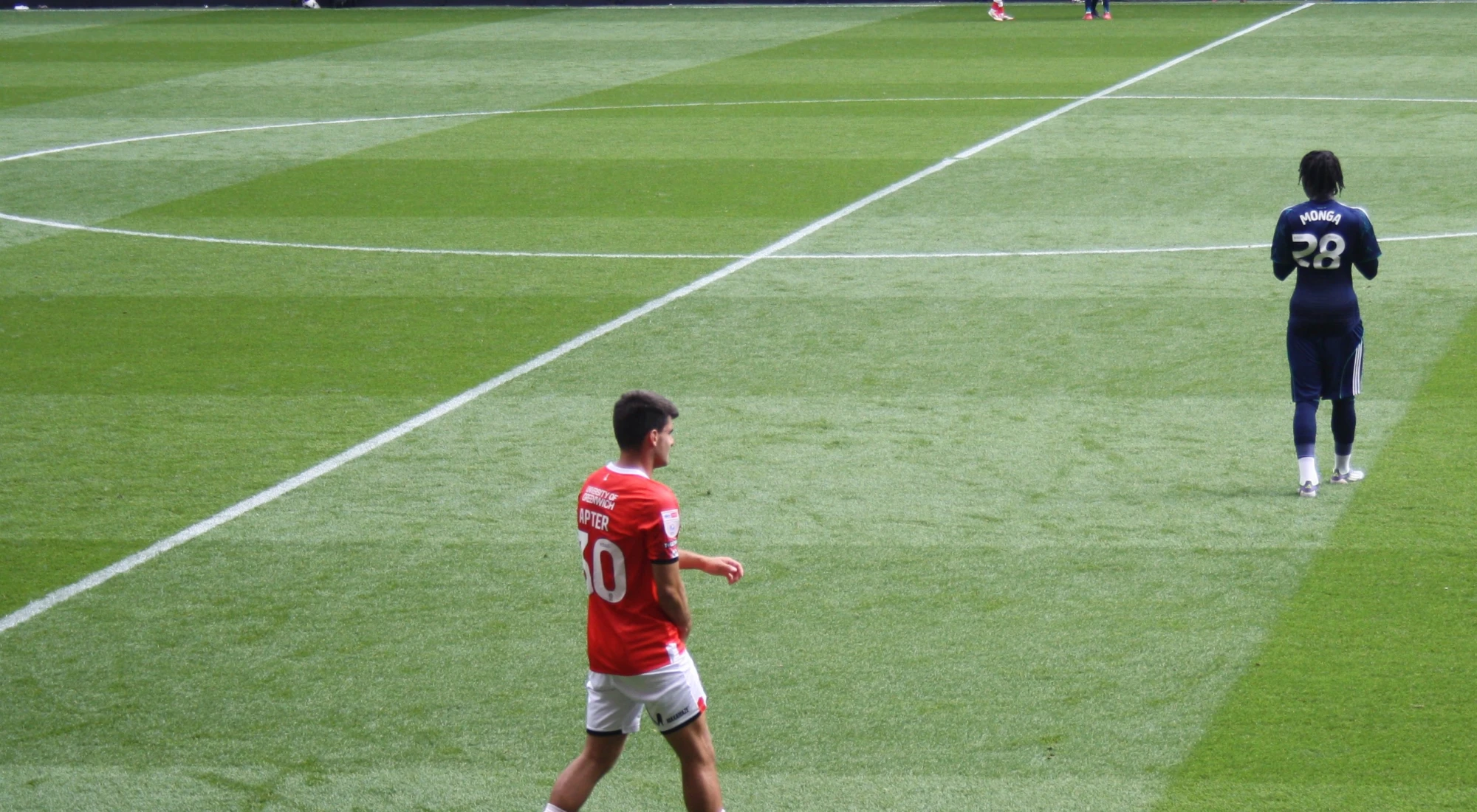
Jeremy Monga is arguably the clearest example of this profile emerging in English football.
At just 16 years old, the Leicester City winger has emerged as one of England’s brightest young prospects, attracting interest from several Premier League clubs after an eye-catching breakthrough campaign. His numbers may remain modest—one goal and two assists in the Championship—but they tell only part of the story. Monga’s greatest strength is not measured by goals or assists. It is measured by how consistently he creates separation before bursting past his man.
Everything in his game is designed to create that advantage.
Somewhat reminiscent of Jeremy Doku, perhaps the most striking aspect of Monga’s profile is that the dribble often begins before he even receives the ball. Repeated scans over his shoulder allow him to understand the defender’s position, while his open body shape ensures his first touch is almost always taken facing forward. Rather than simply controlling possession, he is already preparing to attack it.
That sequence explains why defenders so often find themselves reacting instead of dictating. Monga rarely overwhelms opponents through raw pace alone. His first touch immediately invites a decision. Commit too early and he shifts direction. Stand off and he accelerates into the space in front of him. Add subtle shoulder drops, sharp changes of direction and an explosive first step, and the duel is often decided before a defender can think about putting a tackle in.
Creating separation is not merely the outcome of Monga’s dribbling. It is the objective.
The numbers reinforce that impression. During the 2025/26 Championship season, Monga averaged 2.5 completed dribbles per 90 minutes, ranking fourth across the division despite playing fewer than 1,000 senior minutes. He also ranked among the Championship’s strongest performers for progressive carries, repeatedly driving Leicester from defence into attack through individual ball carrying rather than combination play.
His heat map paints an equally clear picture. Activity is concentrated almost exclusively along the left touchline, stretching from the halfway line into the attacking third. Rather than drifting centrally in search of possession, Monga consistently positions himself to receive in isolation. Once there, his instinct is almost always the same: attack the defender directly.
That distinction matters.
While many young wingers aim for flair and spectacle in order to prove themselves, Monga opts for rapid progression. Every successful take-on forces defensive lines to retreat, draws covering defenders away from their assignments and creates new passing lanes for teammates. His greatest contribution is often not the dribble itself, but the structural damage it leaves behind.
The next stage of his development is clear.
While clearly skilled 1v1, his decision making in the final 3rd leaves much to be desired. There are occasions where he carries the ball for one touch too many, delaying the release pass or driving into crowded areas rather than playing the simple pass inside. Most notably, his final ball lacks consistency, often opting to dig out his crosses rather than to pick out a specific target.
Moreover, his shot volume remains modest and his decision-making in advanced areas has yet to consistently match the quality of his approach play. Improvements in his defensive discipline and off-ball movement will also be required as he adapts to increasingly demanding tactical systems, especially if his expected move to Mikel Arteta’s Arsenal materialises; a team famed for their defensive resilience. However, this is certainly a coachable issue and is one that Arteta would look to work on as he did with Bukayo Saka.
None of those observations feel unusual for a player still only 16 years old. If anything, they underline how advanced the strongest part of his game already is.
Every young winger develops differently. Some learn to produce before they learn to beat defenders. Others master the duel long before the final pass consistently follows.
Jeremy Monga already appears to possess one of football’s rarest traits: the ability to repeatedly create separation from his direct opponent. Whether that separation ultimately becomes goals, assists or something greater will depend on the next phase of his development.
The hardest part, however, may already be there.
All stats taken from FBref.